


Get Free Ebook The Essays (Penguin Classics), by Francis Bacon
Checking out book The Essays (Penguin Classics), By Francis Bacon, nowadays, will certainly not force you to constantly buy in the store off-line. There is a fantastic place to acquire guide The Essays (Penguin Classics), By Francis Bacon by on the internet. This site is the very best website with great deals varieties of book collections. As this The Essays (Penguin Classics), By Francis Bacon will certainly remain in this book, all books that you need will correct here, also. Simply search for the name or title of guide The Essays (Penguin Classics), By Francis Bacon You could find exactly what you are hunting for.
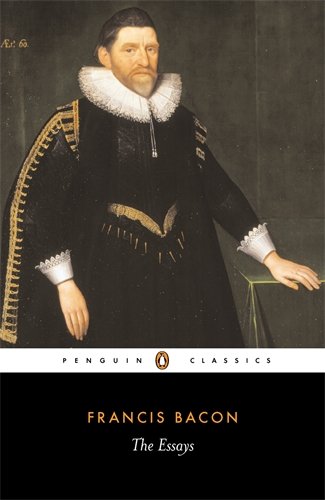
The Essays (Penguin Classics), by Francis Bacon

Get Free Ebook The Essays (Penguin Classics), by Francis Bacon
This is it the book The Essays (Penguin Classics), By Francis Bacon to be best seller lately. We give you the very best offer by getting the incredible book The Essays (Penguin Classics), By Francis Bacon in this internet site. This The Essays (Penguin Classics), By Francis Bacon will certainly not only be the kind of book that is tough to locate. In this website, all kinds of books are provided. You can look title by title, author by author, as well as author by author to discover the best book The Essays (Penguin Classics), By Francis Bacon that you can read now.
But here, we will show you amazing point to be able always check out guide The Essays (Penguin Classics), By Francis Bacon wherever as well as whenever you happen and also time. The book The Essays (Penguin Classics), By Francis Bacon by just can aid you to recognize having the e-book to review every single time. It will not obligate you to always bring the thick e-book wherever you go. You can merely keep them on the gadget or on soft data in your computer to always check out the area at that time.
Yeah, investing time to check out the e-book The Essays (Penguin Classics), By Francis Bacon by online can additionally provide you positive session. It will certainly ease to talk in whatever condition. In this manner could be much more interesting to do and also less complicated to check out. Now, to obtain this The Essays (Penguin Classics), By Francis Bacon, you can download in the link that we provide. It will certainly aid you to obtain simple means to download and install the book The Essays (Penguin Classics), By Francis Bacon.
Guides The Essays (Penguin Classics), By Francis Bacon, from basic to challenging one will be a quite useful operates that you can require to alter your life. It will not provide you unfavorable statement unless you do not get the significance. This is undoubtedly to do in checking out a book to get rid of the meaning. Frequently, this e-book entitled The Essays (Penguin Classics), By Francis Bacon is reviewed considering that you really such as this kind of e-book. So, you could obtain easier to recognize the perception as well as significance. Once more to consistently bear in mind is by reading this book The Essays (Penguin Classics), By Francis Bacon, you could satisfy hat your curiosity beginning by completing this reading book.
The genius of Francis Bacon is nowhere better revealed than in his essays.
Bacon’s education was grounded in the classical texts of ancient Greece and Rome, but he brought vividness and color to the arid scholasticism of medieval book-learning. Whatever their subject, whether it is something as personal as “Friendship” or as abstract as “Truth,” the essays combine a mixture of rhetoric and philosophy; and are perhaps the most complete and rounded examples of Bacon’s literary style.
Rather than merely summarizing popular philosophy or producing glib expositions of correct conduct, Bacon attempted to change the shape of the other men’s minds. He believed rhetoric, as the force eloquence and persuasion, could incline the mind towards the pure light of reason.
- Sales Rank: #669578 in Books
- Published on: 1986-01-07
- Released on: 1986-01-07
- Original language: English
- Number of items: 1
- Dimensions: 7.73" h x .67" w x 5.07" l, .53 pounds
- Binding: Paperback
- 288 pages
From the Publisher
Founded in 1906 by J.M. Dent, the Everyman Library has always tried to make the best books ever written available to the greatest number of people at the lowest possible price. Unique editorial features that help Everyman Paperback Classics stand out from the crowd include: a leading scholar or literary critic's introduction to the text, a biography of the author, a chronology of her or his life and times, a historical selection of criticism, and a concise plot summary. All books published since 1993 have also been completely restyled: all type has been reset, to offer a clarity and ease of reading unique among editions of the classics; a vibrant, full-color cover design now complements these great texts with beautiful contemporary works of art. But the best feature must be Everyman's uniquely low price. Each Everyman title offers these extensive materials at a price that competes with the most inexpensive editions on the market-but Everyman Paperbacks have durable binding, quality paper, and the highest editorial and scholarly standards.
About the Author
Francis Bacon, philosopher, essayist, lawyer and statesman, was born in London in 1561. He studied at Cambridge and was enrolled at Gray’s Inn in 1576. In 1584 he entered Parliament as the member for Melcombe Regis, subsequently representing other constituencies. Bacon made the acquaintance of the Earl of Essex, who endeavored to advance him in his career. Nevertheless, having been appointed to investigate the causes of Essex’s revolt in 1601, Bacon was largely responsible for the earl’s conviction. Bacon was appointed Solicitor-General in 1607 and was successively Attorney-General (1613), Lord Keeper (1617) and Lord Chancellor (1618). He was created Baron Verulam in 1618 and Viscount St. Albans in 1621. Later in that year he was charged with bribery and confessed that he had been guilty of ‘corruption and neglect’ but denied that he had ever perverted justice. He was deprived of the Great Seal, fined, imprisoned in the Tower and disabled from sitting in Parliament. Following his release, he retired to the family home at Gorhambury, Hertfordshire, and his remaining years were spent in literary and philosophical work. It was Bacon’s ambition to create a new system of philosophy to replace that of Aristotle, and he has been justly acclaimed as an inspiration to later scientists, rationalists and materialists. Of his philosophical works, the principal and best known are The Advancement of Learning, Novum Organum and De Augmentis. He also wrote several professional works including Maxims of the Law and Reading on the Statue of Uses. Of his literary writings the most important are the Essays (1597; issued in final form in 1625), De Sapientia Veterum, Apophthegms New and Old and a History of Henry VII. Francis Bacon died in 1626
Most helpful customer reviews
2 of 2 people found the following review helpful.
Sir Francis Alban
By Thorrin Jonsson
There is not much here to say that the other reviewers have not covered: Sir Francis was a truly sharp witted mind, and knew how to write good prose, and how to run his topics and resolutions home to the reader. As style goes, I personally go easily between Aristotle and Bacon in the same day, and often. To me I see much of Aristotle in Francis' works (as in his high-formal writing style), yet it seems he did not know Greek. Most of his quotations and analogies he draws from Latin writers (a large proportion seems to be Virgil and Tacitus; midst a handful of others strewn throughout).
As far as Sir Francis' writing goes, theres little bad to say, and a lot of good. This is worth reading for any philosopher, or even anyone trying to get a good hold of formal prose. He might to some seem a tad difficult to read at first, but it shouldn't prove a real obstacle for anyone actually interested in the reading -- after you read just a couple of his essays, you will likely start to get used to his style quickly. I suggest looking in the Contents and just picking out a few that look like topics you couldn't deny interest - that will get you hooked, and into the style.
As for the editor John Pitcher, there are many good things, but a certain terribly annoying quality that weighs as heavy as all the good in my opinion.
For those who do not know Latin extensively (i.e., limited vocabulary and grammar, or none at all) the annotations are of course great and indispensable. Pitcher also generously untangles Francis' allusions and such, which are helpful also at times.
But something that he (Pitcher) follows in other editors of Bacon's works, is complete asinine glossing of words in context which makes complete sense. And he does this extensively. Oftentimes in a work that actually does have an archaic vocabulary, the first glossing of the word is taken to carry its meaning through the essay, but though "estate" is used 10 times in the 2-3 page essay Pitcher will put a note at each occurrence and gloss "state" (not to mention in its context the glossing of that word is obvious and unnecessary). The amount of 'archaic' vocabulary is small and simple throughout the book; a half-page glossary could've been supplied instead of bogging the pages down with redundant annotations of obvious words and thus hurting the actually important annotations.
But all that said, this is still a great edition, a great book, great author, and even by the above facts this is probably the best publication of Francis' essays. The annoying glossing isn't too bad after you get used to it.
0 of 0 people found the following review helpful.
Francis Bacon's "The Essays"
By Book Lover
I first encountered Francis Bacon's "Essays" many, many years ago during college. My copy was a college library edition, so it did not remain a part of my permanent collection. However, some 25+ years later, I purchased the Penguin Classics edition to reread and reminisce about my school days, and I was not disappointed. Personally I found his essays fascinating, eloquent, philosophical, and brilliant. If I were in the same line of work I was in 15 years ago, I would study and memorize some of his quotes and use them in arguments with my colleagues and especially against my enemies.
0 of 0 people found the following review helpful.
Five Stars
By Grant
Read more Bacon for daily meditations.
The Essays (Penguin Classics), by Francis Bacon PDF
The Essays (Penguin Classics), by Francis Bacon EPub
The Essays (Penguin Classics), by Francis Bacon Doc
The Essays (Penguin Classics), by Francis Bacon iBooks
The Essays (Penguin Classics), by Francis Bacon rtf
The Essays (Penguin Classics), by Francis Bacon Mobipocket
The Essays (Penguin Classics), by Francis Bacon Kindle
0 komentar:
Posting Komentar